11 // OPTICAL BIOPROGRAMMING
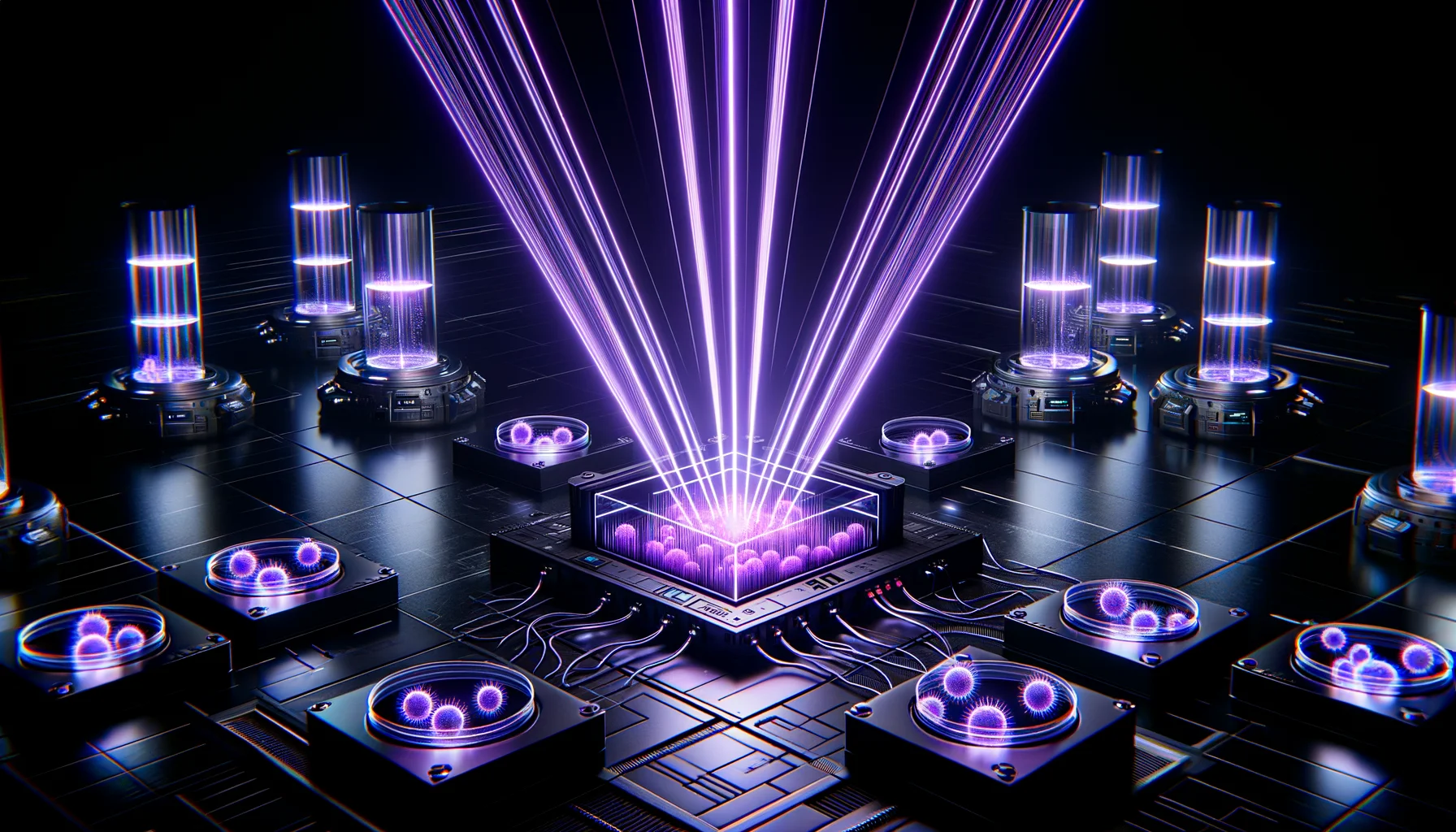
Current genetic engineering depends on physical delivery: viral vectors, electroporation, lipid nanoparticles. Each method has payload limits, cytotoxicity costs, and targeting constraints. Generative Optogenetics (GO) proposes replacing chemical delivery with optical control — using light-sensitive enzymes already established in optogenetics research (Channelrhodopsin-2 at 470 nm, CRY2-CIB1 photodimerization at 488 nm) as the foundation for a programmable genetic writing system.
The concept: molecular machines expressed inside living cells translate wavelength-encoded optical signals into nucleotide sequences. A 405 nm pulse triggers adenine incorporation; 488 nm triggers cytosine; 532 nm guanine; 635 nm thymine. The cell writes its own genetic code in response to structured illumination. Precision light sources — tunable UV lasers and full-spectrum emitter arrays — are supplied by Maxwell Continuum. No such wavelength-to-nucleotide system has been demonstrated; this is a research direction, not a current capability.
HOW IT WORKS
THE BIOLOGICAL TAPE WRITER
Engineered photosensitive enzymes respond to specific light wavelengths by catalyzing nucleotide incorporation into a growing DNA or RNA strand. Each wavelength maps to a specific base pair. The cell becomes a programmable genetic printer controlled by light rather than chemistry.
SINGLE-CELL RESOLUTION
Because light can be focused to sub-micron precision, GO operates at individual cell resolution within a tissue. Adjacent cells can receive different genetic instructions simultaneously. This enables spatial patterning of genetic programs across organs, tissues, and organisms—programming biology the way a laser printer programs a page.
NO DELIVERY PROBLEM
The GO machinery is expressed once and remains active indefinitely. No repeated viral transduction. No electroporation. No lipid nanoparticles. The cell already contains everything it needs—it just waits for the light.
APPLICATIONS
- Regenerative medicine: spatially patterned tissue repair programs
- On-demand molecular manufacturing: cells that produce custom proteins, enzymes, or materials on optical command
- Space-mission biology: remote genetic reprogramming of onboard biological systems without physical contact
- Living architecture: biological components for Modular Habitats that grow, adapt, and self-repair under optical control