08 // Biological Assembly Roadmap
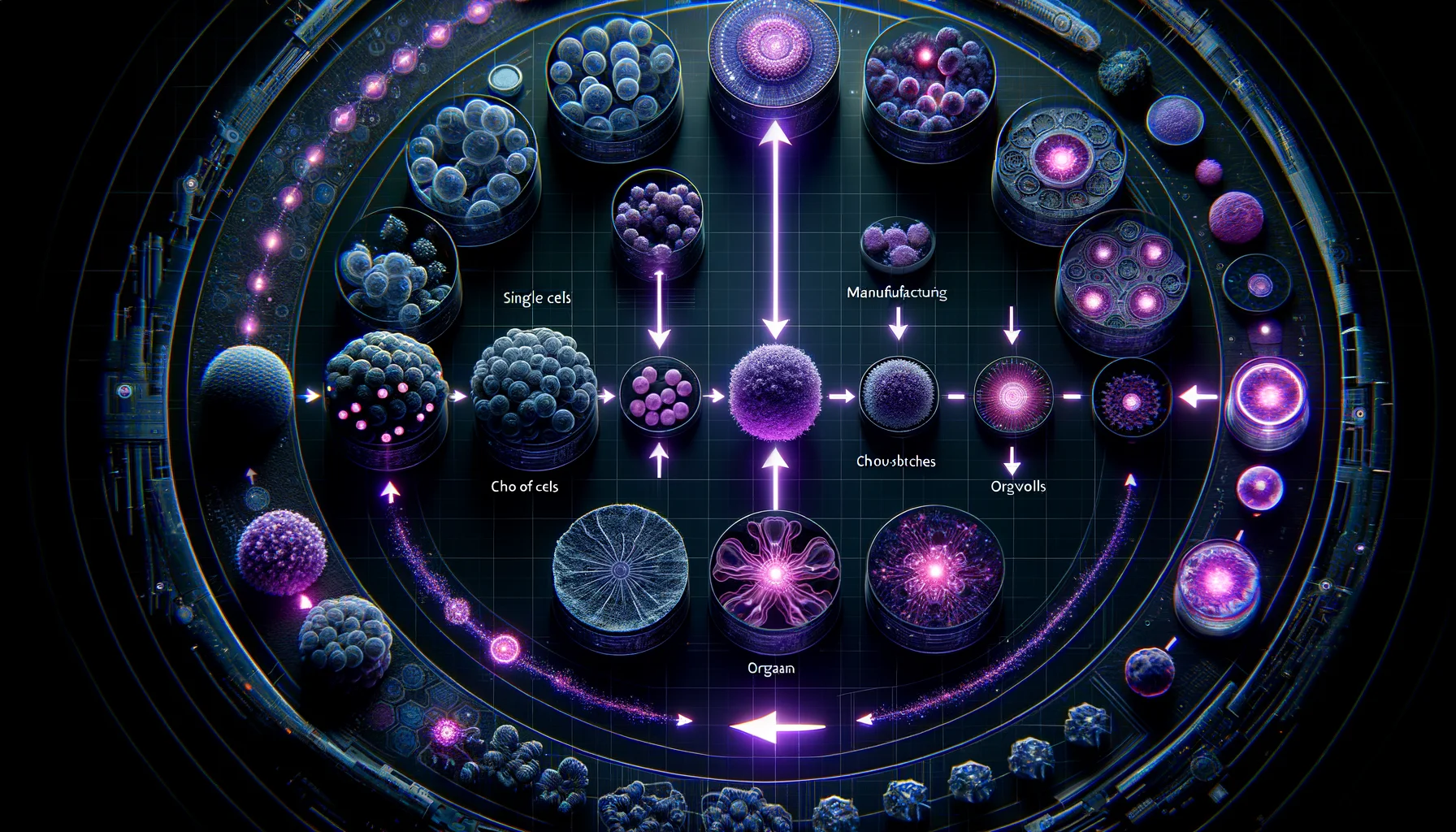
Synthetic organism assembly is a sequencing problem. Each phase has defined inputs, outputs, and failure modes. The roadmap below outlines the manufacturing progression from raw feedstock to integrated biological systems.
PHASE 0
RAW FEEDSTOCK
Organic sludge, amino acid slurry, mineral solution. Feedstock composition: yeast-fermented amino acid concentrate (20 canonical + 4 synthetic), mineral electrolyte solution calibrated to cytoplasmic ionic strength, growth factor cocktail (IGF-1 analog, EGF analog, VEGF analog), and scaffold polymer precursors (collagen-analog, fibronectin-analog, laminin-analog). No animal products. No serum. The feedstock is entirely synthetic.
PHASE 1
CELL FABRICATION
Individual SBCs assembled from molecular components in cell-free synthesis reactors. The SBC chassis is not grown from stem cells; it is constructed. Ribosomes extracted and purified, then supplied with synthetic mRNA encoding the target cell proteome. Cell membrane lipid bilayers are extruded around the assembled protein machinery. Nucleus analog containing the checksum-protected synthetic genome is inserted last. Yield per 10L synthesis reactor: ~109 viable SBCs per 6-hour run.
PHASE 2
TISSUE ASSEMBLY
SBCs organized into functional tissue layers via directed deposition. Cells are loaded into bioprinter cartridges and extruded onto scaffold polymer bases in defined geometries. Chemical gradient signals (morphogens) guide cell positioning: high-concentration zones attract specific SBC types; cells migrate and adhere. Layer-by-layer deposition builds 3D tissue structures at 50-micron resolution. Assembly time for a 10cm³ tissue block: 4 hours at standard throughput.
PHASE 3
ORGAN CONSTRUCTION
Complete organs with SBC-V vascular perfusion and SBC-N neural innervation. This phase integrates all SBC classes into a functional unit. Tissue blocks from Phase 2 are assembled around an SBC-V vascular scaffold; nutrient and oxygen delivery to every cell is established before the outer tissue layers are deposited. SBC-N clusters are seeded into the organ at defined innervation points; axonal growth factors guide neural extension through the tissue over 72 hours. Functional verification: perfusion pressure test, electrical response mapping, metabolic output assay. We are at Phase 3.
PHASE 4 (ADVANCED ENGINEERING)
MULTI-ORGAN SYSTEM INTEGRATION
Multiple organs connected into functional biological systems. Circulatory, nervous, and metabolic subsystems integrated through shared SBC-V vascular networks and SBC-N neural pathways. This phase requires solving the anastomosis problem at scale—connecting independently grown organ constructs into a single perfused, innervated system. Currently in early research.
PHASE 5 (RESEARCH HORIZON)
AUTONOMOUS BIOLOGICAL SYSTEMS
Self-sustaining biological constructs capable of independent metabolism, environmental response, and self-repair. This phase depends on solutions to multi-organ integration, metabolic homeostasis, and biological control architecture that are not yet demonstrated at scale. A long-horizon research objective, not a near-term product target.
Current capability: Phase 3. Organs and tissue constructs from patient-specific cell lines.