03 // THE PRODUCT HIERARCHY
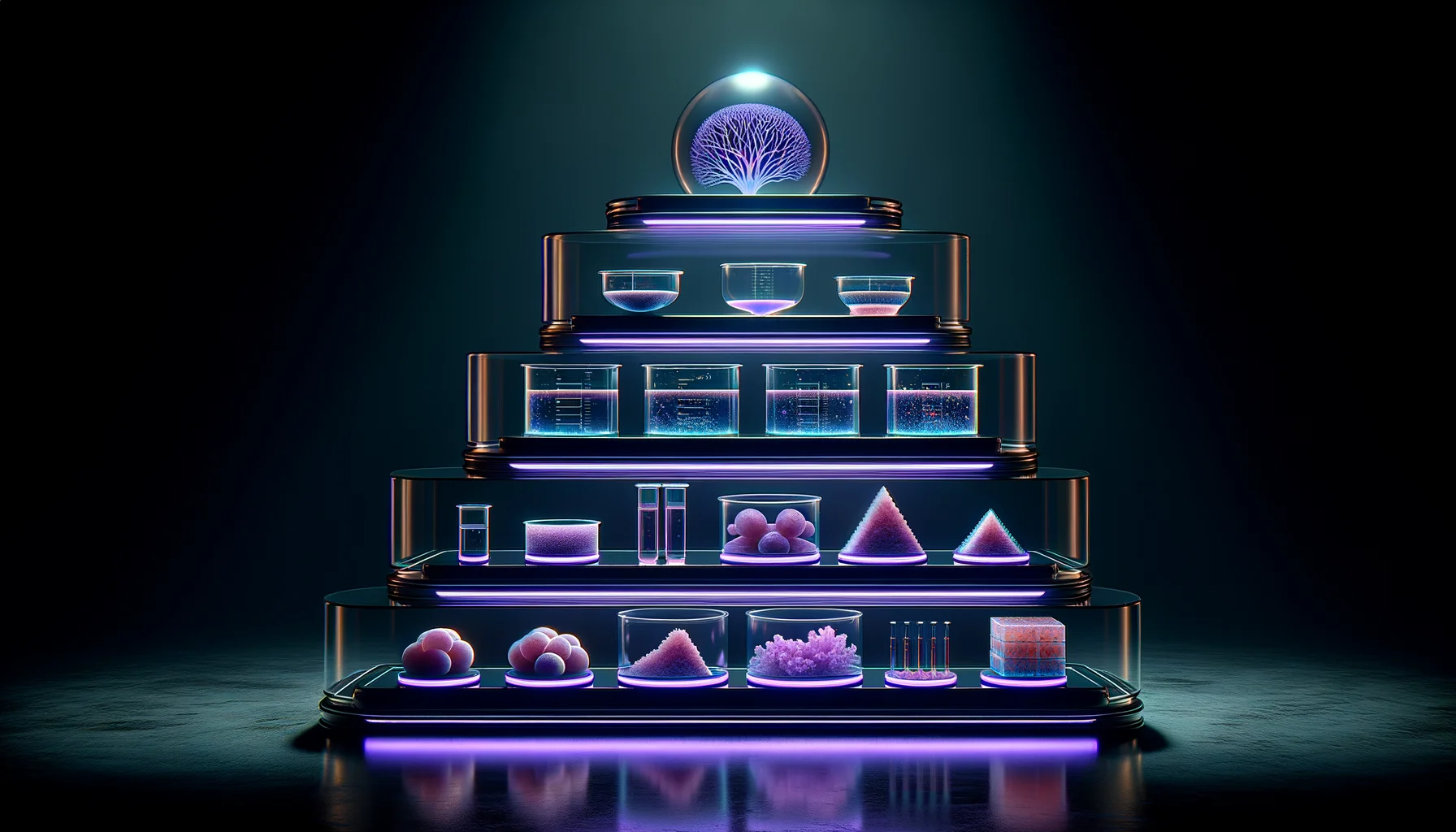
Cellular Foundry's output spans four tiers of increasing biological complexity, each with distinct manufacturing timelines, quality requirements, and maturity levels. Tier 1 products ship today from existing biomanufacturing platforms. Tier 4 remains a research horizon.
TIER 1 — CELL LINES & BIOMATERIALS
Feedstock Products
Stem cell slurries at 107 cells/mL suspended in hyaluronic acid nutrient gel for bioprinting applications. Shelf life: 72 hours at 4°C. Matter Kitchen uses cell lines for cultured meat production. Hospitals use them for skin grafts and wound coverage. Yield: approximately 109 cells per BRX-1 run.
Engineered living materials: bio-cements that self-heal cracks through embedded bacterial calcification. Structural bio-composites that grow, repair, and respond to environmental conditions.
TIER 2 — ORGANS & TISSUE CONSTRUCTS
Biofabricated Functional Tissue
Patient-specific organs bioprinted from the recipient's own cell profile—eliminating immune rejection. Liver, kidney, and cardiac constructs produced in BRX-series bioreactors with integrated SBC-V vascular perfusion. Current focus: solid organs with straightforward perfusion requirements.
Specialty constructs: cartilage sheets, vascular grafts, bone implant scaffolds, and neural interface tissue for Brainwave Systems BCI applications.
TIER 3 — BIO-ACTUATORS & HYBRID SYSTEMS (ADVANCED ENGINEERING)
Biological-Mechanical Integration
Engineered muscle-fiber actuators, bio-electronic sensor arrays, and hybrid constructs that combine biological tissue with conventional mechanical or electronic systems. Primary applications: prosthetic actuators for Foundation Kinetics, biocompatible sensor platforms, and soft robotics research.
TIER 4 — ORGANISM-SCALE ENGINEERING (RESEARCH HORIZON)
Future Biology
Full synthetic organism design, engineered living architectures (structural biology that grows and self-repairs under programmatic control), and environmental bioremediation organisms. These are long-horizon research directions that depend on advances in multi-organ system integration, metabolic engineering, and biological control theory. Not current product offerings.